
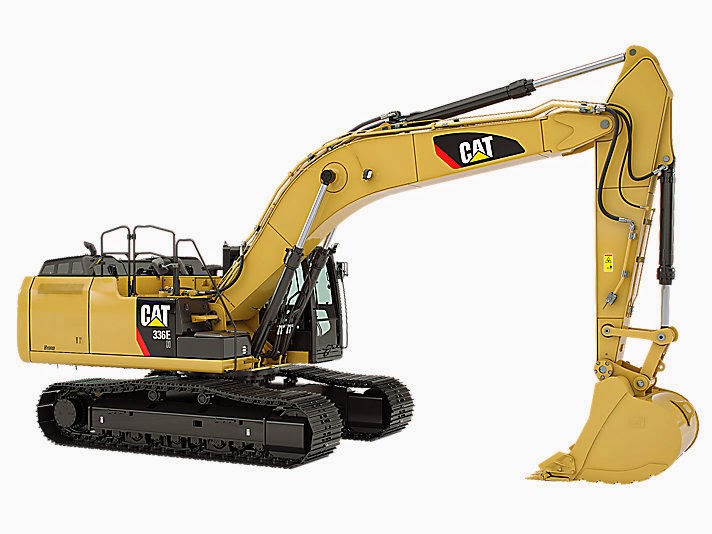
Hi Cat makes a big impact with its hybrid excavator!.
.jpg)
Hybrid technology for most people conjures up visions of fuel-efficient cars with conventional gasoline power supplemented by electrical power. For those of us involved in the fluid-power industry, however, hybrid usually means hydraulic, where accumulators — not batteries — store energy. That’s the case for Caterpillar’s 336E H hybrid excavator.
The hybrid option adds about 9% to the cost of a conventional 336E. That’s a substantial amount, but smart buyers will realize that they will quickly recover an even more substantial amount in fuel savings. In general, the payback period is about 2,000 hr of operation. Furthermore, the hydraulic hybrid drive carries a much lower price add-on than an electric hybrid drive would. That’s because the hydraulic version doesn’t carry the high price tag associated with electrical generators, motors cabling, and other components required for electric hybrids.

The 336E H captures and reuses energy in its swing drive, which holds high potential for saving energy. In a typical scenario, an excavator digs earth from the ground, raises it, then swings about 90° to dump the material. So by storing braking energy in accumulators at the end of each dig-and-dump operation, the swing drive can recycle most this energy for acceleration at the beginning of each cycle.
Using recycled hydraulic energy means less mechanical energy is needed from the engine. This lightens the load on the engine, which conserves fuel. Caterpillar officials estimate that the 336E H may consume 25% less fuel than its conventional counterpart, and 50% less fuel than a 336D Series.
Hybrid drive swings into action:
.jpg)
The heart of the Cat hybrid system is an axial-piston hydraulic pump. It features electronic variable-displacement control and is the same used in other Cat machines, just repurposed for the excavator. Electronic controls monitor engine speed and automatically adjust pump displacement so that pressure and flow closely match demand.
Controlling fluid directional control is Caterpillar’s Adaptive Control System (ACS) valve. The ACS valve provides independent control of multiple functions by managing inlet and outlet flow restrictions to and from each circuit of the machine to maximize performance.
No additional valves are necessary for
flow regeneration of the boom, stick or bucket cylinders.
Fuel savings mean quick ROI:
.jpg)
Some other “hybrid” excavators use an electric motor in the swing drive and store power in batteries. These systems carry a high initial cost and provide less fuel savings than Cat’s hydraulic hybrid. Plus, the 336E H also recycles energy from boom, stick, and bucket cylinders. These cylinders are sized with bores and strokes of 5.9 × 56.7 in., 6.7 × 68.4 in., and 5.9 × 45.3 in., respectively. Their combined volumes provide a substantial opportunity to store energy when cylinders retract and recycle it when cylinders extend.
One goal of this equipment program, of course, is fuel savings, which comes partially from recycling much of the swing and braking energy. However, substantial fuel conservation can also be attributed to the ACS valve, which allows a lower operating speed of the C9 engine — 1,800 rpm instead of 1,500. The lower speed also helps reduce the noise level of the machine but without sacrificing performance, thanks to the ACS valve. The swing and digging speeds were all kept the same as the 336D and E Series.
More hybrids on the horizon:
.jpg)
Caterpillar already plans to offer hydraulic hybrid versions of its 336F and 336D Series. They say larger excavators and wheel loaders can also benefit from the technology. However, incorporating the technology into smaller machines would not offer as fast of a return on investment. Therefore, no immediate plans exist for hydraulic hybrids in smaller machines.
According to Ken Gray, global product manager for Caterpillar’s large hydraulic excavator, ROI is what’s going to make the technology attractive to contractors. He said contractor focus groups consistently communicated to him that they are most interested in reliability and productivity, not their carbon footprint. They also made it clear that they didn’t want a seven-year payback period or a technology that was complicated and expensive to maintain.
Gray explained that this information is what drove the program. Caterpillar R&D had started developing electric hybrids but still kept hydraulic hybrid development moving on a parallel path. However, the performance, price, and familiarity of the hydraulic system won out over electric hybrid.
This result emphasizes the fact that even though hydraulics is considered a mature technology, it continues to evolve by incorporating the latest in electronics, design concepts, and, especially, new ways of reapplying established principles.
Hi EXPLORE MORE!!!....,
Hi WATCH NOW!!!.
Hi Interview with Caterpillar's Product Manager!
!!!THANK YOU FOR VIEWING!!!





 Posts
Posts

